What Does It Mean When Your Left Ear Rings? Ringing in one ear — specifically the left ear — is one of those experiences that tends to make people more anxious than ringing in both ears. There is something about the one-sidedness of it that feels more significant. More deliberate. Like your body is trying to tell you something specific. One of the most common concerns people have is whether it will last—raising the question: is tinnitus permanent?
And in some cases, it is.
Unilateral tinnitus — the medical term for ringing in one ear only — does warrant slightly more attention than bilateral tinnitus. Not because it is necessarily more dangerous, but because the list of possible causes is somewhat different, and a few of them are important to rule out.
Let me walk you through what the science actually says about left ear ringing — what commonly causes it, what the spiritual explanations are and why they exist, and most importantly what you should actually do about it.
What does it mean when your left ear rings? In many cases, the explanation is medical rather than mysterious. —especially if you recently experienced sudden symptoms and are wondering why your ear is ringing all of a sudden.
Does It Actually Matter Which Ear Is Ringing?
Medically speaking — yes, it can matter.
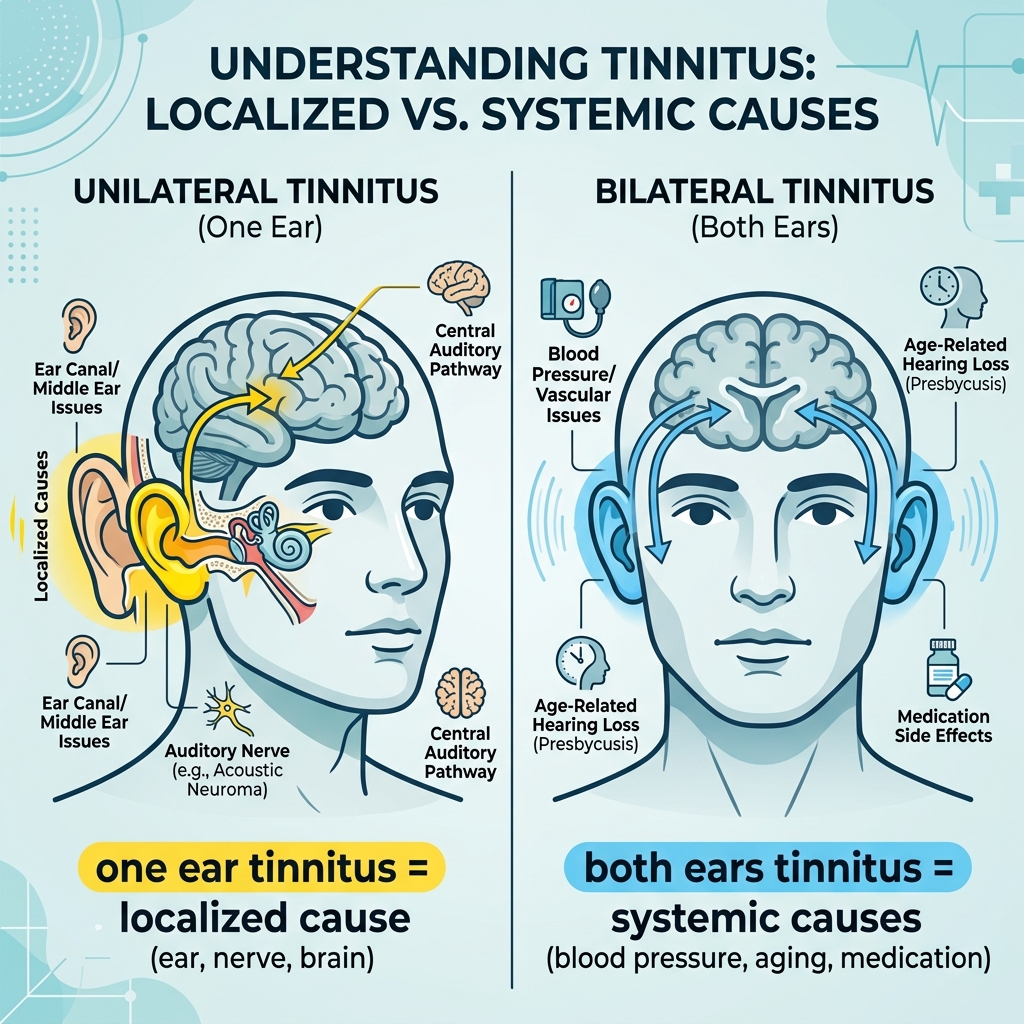
When tinnitus affects both ears equally, it is most commonly associated with systemic causes — age-related hearing loss, noise damage, blood pressure issues, or medication side effects that affect the whole auditory system.
When tinnitus affects only one ear — whether the left or right — it is more likely to have a localised cause. Something affecting that specific ear, the nerve connected to it, or the part of the brain that processes sound from that side.
This does not mean one-sided tinnitus is more serious — most of the time it is not. But it does mean the diagnostic process is slightly different, and ruling out certain causes becomes more important.
As for whether the left ear specifically means something different from the right ear — medically, no. The left and right auditory systems are mirror images of each other. Left ear ringing has the same range of possible causes as right ear ringing.
Spiritually, many cultures have different beliefs about left versus right. We will touch on that briefly — but let us start with the science.
Common Medical Causes of Left Ear Ringing
1. Noise Damage to the Left Ear Specifically
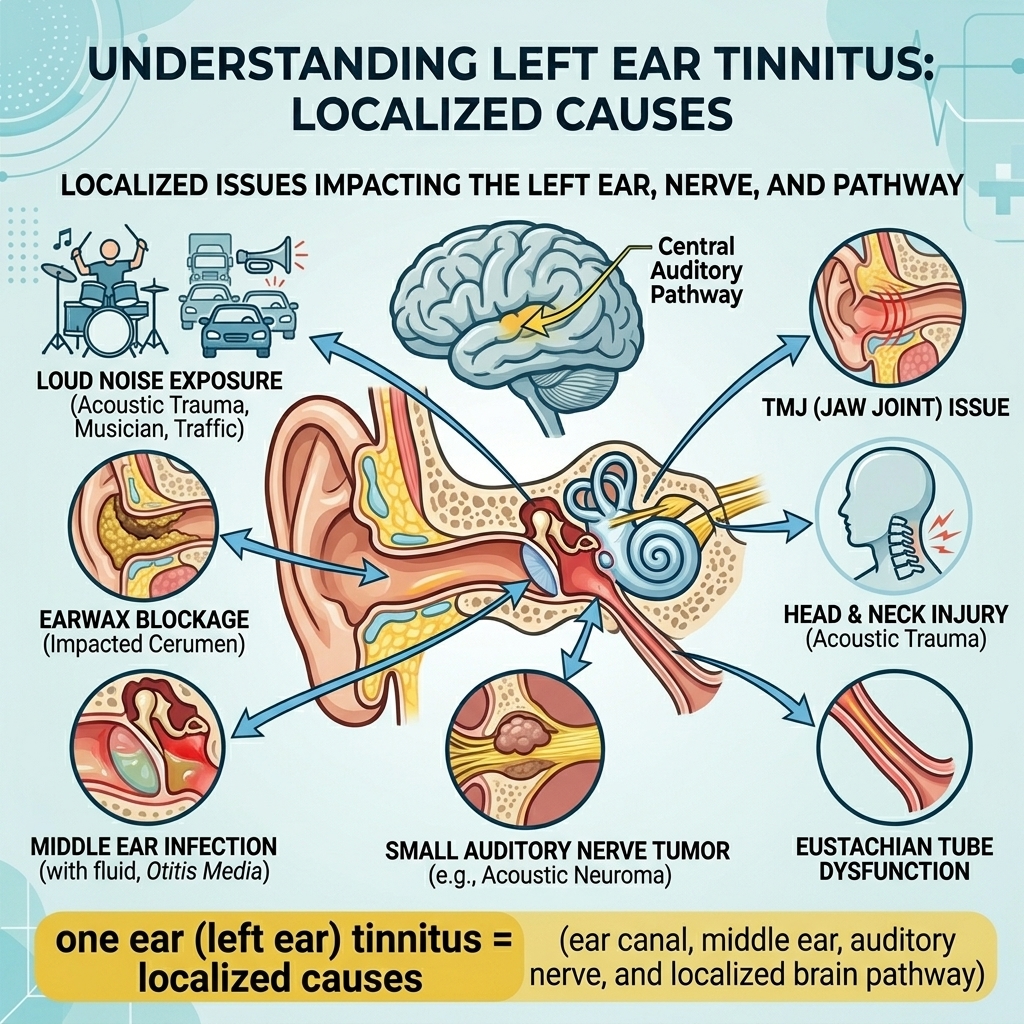
One of the most common reasons tinnitus develops in one ear rather than both is asymmetric noise exposure.
Think about situations where one ear consistently receives more sound than the other:
- Musicians who stand near a specific instrument during performances
- People who hold their phone to one ear consistently
- Drivers whose left ear faces an open window on motorways
- Shooting sports participants who do not use ear protection — the left ear of a right-handed shooter takes more blast exposure
If you can identify a consistent source of sound exposure that favours your left ear — that is almost certainly the explanation for why your tinnitus is one-sided.
What to do: Protect your left ear from further noise exposure. The tinnitus may not reverse — but preventing additional damage is critical.
2. Earwax or Blockage in the Left Ear
This is genuinely one of the most common causes of sudden one-sided tinnitus — and also one of the most easily resolved.
Earwax buildup that creates pressure against the left eardrum can cause ringing, muffled hearing, or a feeling of fullness in that ear only. It can happen gradually as wax accumulates, or suddenly if a piece of wax shifts position.
The tell-tale signs are ringing accompanied by a feeling of blockage or muffled hearing in the same ear. Sometimes you can almost feel the pressure.
What to do: Do not use cotton buds or attempt to remove the wax yourself. See a pharmacist about ear drops or visit your doctor for professional ear irrigation. Once the blockage is cleared, the ringing almost always resolves completely.
3. An Ear Infection Affecting the Left Ear
Middle ear infections — otitis media — cause inflammation and fluid buildup behind the eardrum. This changes the pressure in the ear and disrupts normal hearing function, often producing tinnitus in the affected ear.
Outer ear infections — otitis externa, sometimes called swimmer’s ear — can cause similar symptoms by blocking the ear canal.
Either type of infection can cause one-sided ringing that often resolves once the infection is treated.
Additional signs that an infection may be causing your left ear ringing:
- Pain or tenderness in the ear
- Feeling of fullness or pressure
- Muffled hearing in the same ear
- Recent cold or upper respiratory infection
- Discharge from the ear
What to do: See a doctor. Ear infections typically require medical treatment — either antibiotics for bacterial infections or specific antifungal treatment for fungal outer ear infections.
4. A Head or Neck Injury
Head and neck trauma can damage the inner ear, the auditory nerve, or the brain regions that process sound from one side. The result is often tinnitus that presents in one ear only — whichever side sustained more impact.
This includes relatively minor injuries like whiplash from a car accident, a blow to one side of the head, or even dental procedures that put strain on the jaw joint near the ear.
Interestingly, some people find that their tinnitus changes when they move their head or neck — turning left or right, looking up or down. This is called somatosensory tinnitus and is a clue that the musculoskeletal system is involved in generating or modulating the sound.
What to do: If tinnitus appeared after a head, neck, or jaw injury — mention this specifically to your doctor. Physiotherapy, chiropractic care, or dental treatment for temporomandibular joint (TMJ) disorders can sometimes reduce or resolve injury-related tinnitus.
5. TMJ Disorder
The temporomandibular joint — the hinge that connects your jaw to your skull — sits directly in front of the ear canal on both sides. When this joint becomes inflamed or misaligned, it can directly affect the surrounding ear structures and produce tinnitus.
TMJ-related tinnitus is often one-sided because most people favour one side of their jaw when chewing, clenching, or grinding their teeth. It is frequently accompanied by jaw pain, clicking or popping sounds when opening the mouth, headaches, or facial pain.
If your left ear ringing is accompanied by any jaw-related symptoms — or if you know you clench or grind your teeth — TMJ may be the explanation.
What to do: See a dentist who specialises in TMJ disorders. A mouth guard, physiotherapy, or specific jaw exercises can significantly reduce TMJ-related tinnitus in many cases.
6. Eustachian Tube Dysfunction
The Eustachian tube connects the middle ear to the back of the throat and regulates ear pressure. When it does not open and close properly — due to congestion, allergies, or anatomical issues — the resulting pressure imbalance can cause ringing in the affected ear.
Eustachian tube dysfunction can affect one or both ears, and when it affects only the left it produces left-sided tinnitus. It is often described as a low-pitched ringing or roaring sound, sometimes accompanied by a feeling of fullness or the sensation that sounds are slightly muffled.
What to do: Decongestants, nasal steroid sprays, or steam inhalation can help. If symptoms persist, see an ENT specialist — in some cases a small procedure to insert a pressure-equalising tube in the eardrum provides lasting relief.
7. Acoustic Neuroma — Rule This Out
This is the cause that audiologists and ENT specialists specifically want to rule out when a patient presents with tinnitus in one ear only — particularly if it is accompanied by any degree of hearing loss or balance problems.
An acoustic neuroma — more accurately called a vestibular schwannoma — is a benign (non-cancerous) tumour that grows on the vestibular nerve connecting the inner ear to the brain. As it grows, it can press on the auditory nerve, causing tinnitus and progressive hearing loss in one ear.
I want to be clear: acoustic neuromas are rare and they are benign. They grow slowly and are very treatable when detected. But they are the reason why persistent one-sided tinnitus — especially when accompanied by any hearing change — should always be properly evaluated rather than assumed to be harmless.
Signs that warrant prompt evaluation:
- Tinnitus in one ear only with no obvious cause
- Any degree of hearing loss in the same ear
- Balance problems or dizziness
- A sensation of fullness in the ear
What to do: See your doctor and ask for a referral to an audiologist or ENT. An MRI scan can quickly rule out an acoustic neuroma if one is suspected.
What About the Spiritual Meaning of Left Ear Ringing?

If you searched “what does it mean when your left ear rings” — there is a good chance you have already encountered a lot of content about spiritual meanings. Left ear ringing meaning gossip. Someone talking about you. A warning from the universe. An angel trying to communicate.
These beliefs are ancient and appear across many different cultures. Ancient Romans believed that ringing in the left ear was a bad omen — a sign that someone was speaking ill of you. In contrast, ringing in the right ear was considered positive — a sign that someone was praising you.
Similar beliefs exist in Chinese, Indian, and various Western folk traditions — though the specific interpretations vary considerably from one culture to another.
The scientific position is clear: there is no evidence that ear ringing is caused by supernatural forces or carries spiritual significance. The sound is generated by the auditory system — most likely the brain’s auditory cortex — in response to physical or neurological changes.
That said, I understand why these explanations persist. When you experience something unexplained that medicine sometimes struggles to fully address, looking for meaning is a very human response. There is nothing wrong with finding comfort in spiritual frameworks — just make sure you are also pursuing a medical evaluation so that any treatable cause is not overlooked. Looking for step-by-step relief strategies, here’s a complete guide on how to stop ringing in ears.
When Should You See a Doctor About Left Ear Ringing?
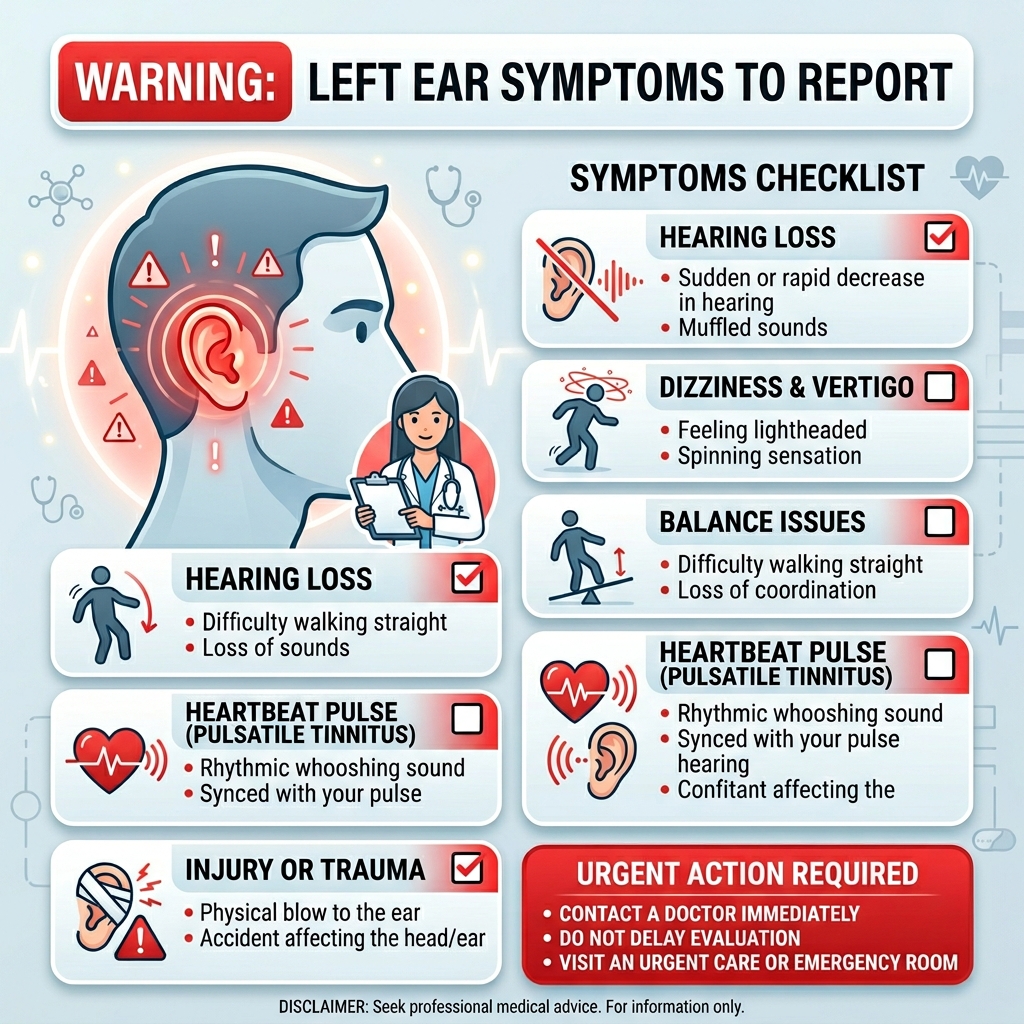
One-sided tinnitus warrants a medical evaluation sooner than bilateral tinnitus in most cases. See a doctor if your left ear ringing:
- Has persisted for more than one week with no obvious cause
- Is accompanied by any degree of hearing loss — even mild or fluctuating
- Comes with dizziness, vertigo, or balance problems
- Pulses in time with your heartbeat
- Appeared after a head, neck, or jaw injury
- Is getting progressively worse
- Is accompanied by a feeling of fullness or pressure that does not resolve
Seek immediate attention if left ear ringing appeared alongside sudden hearing loss in the same ear. This is a medical urgency — treatment within 72 hours produces significantly better outcomes than waiting.
What Can Help With One-Sided Ear Ringing?
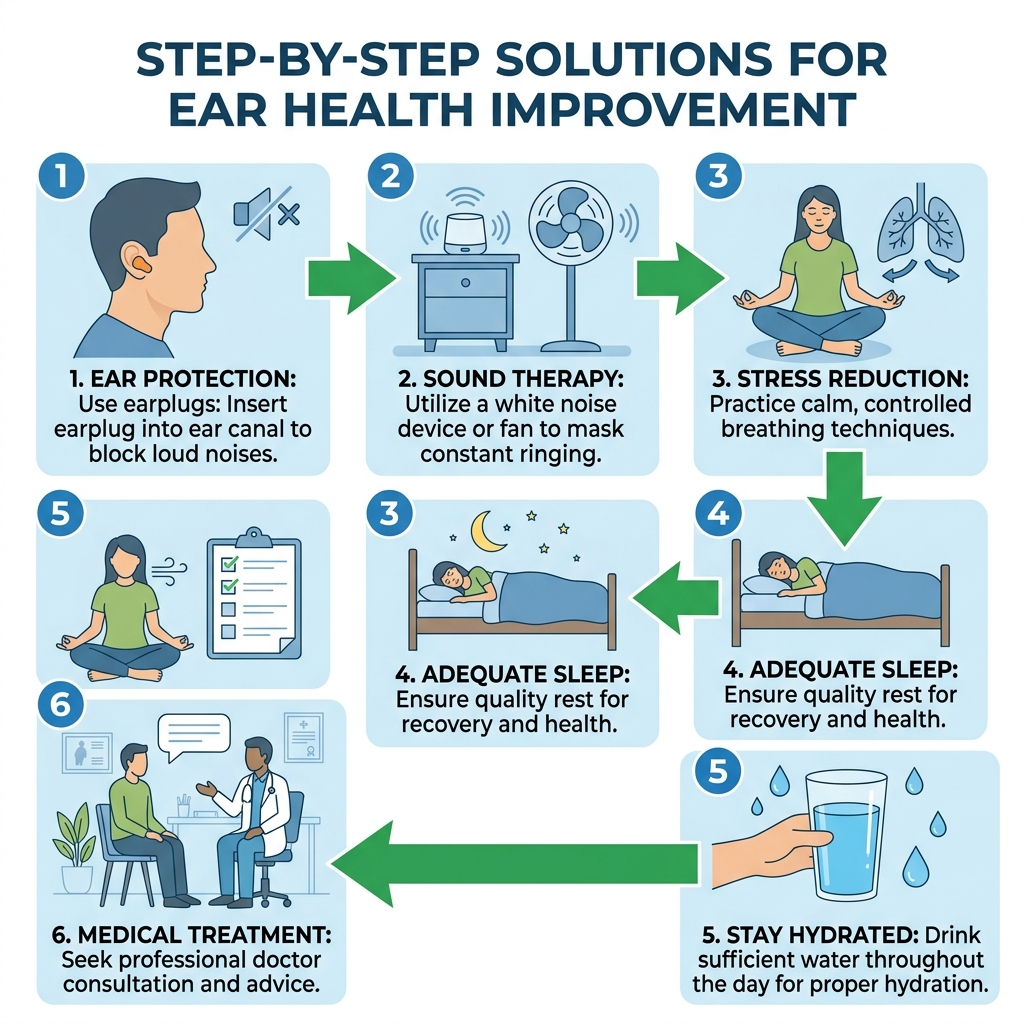
The management approach for left ear tinnitus depends on the cause. But regardless of cause, these general approaches consistently help reduce the impact of tinnitus:
Address any identifiable cause first. Earwax, infection, TMJ, medication side effects, and blood pressure issues are all treatable. Treating the root cause is always the most effective approach.
Use sound therapy. White noise, nature sounds, or a fan at night can mask one-sided tinnitus and make it significantly less noticeable — particularly in the quiet of the evening when it tends to be most intrusive.
Protect your left ear specifically. If noise is a contributing factor — or if you want to prevent further damage — consider using an earplug in your left ear during exposure to loud environments.
Manage stress and sleep. These two factors influence tinnitus intensity more than most people realise. Chronic stress and poor sleep consistently worsen tinnitus — addressing them consistently improves it.
Support your auditory brain health. Since tinnitus is generated in the brain’s auditory cortex rather than the ear itself, approaches that support neural health, inner-ear circulation, and oxidative stress defence address the condition at its actual origin point — regardless of which ear is affected.
Conclusion
Left ear ringing by itself is not inherently more serious than ringing in both ears or the right ear. Most of the time, it has a benign and often treatable cause — noise exposure, earwax, infection, TMJ, or stress.
What makes one-sided tinnitus worth paying slightly more attention to is the small but real possibility of a localised cause that needs to be properly evaluated. Acoustic neuroma is rare — but it is the reason that one-sided tinnitus with hearing changes should not be self-diagnosed and monitored indefinitely at home.
Get it checked. Rule out what needs ruling out. Then focus your energy on active management rather than passive worry.
The ringing in your left ear is your auditory system communicating something — even if the message is simply that it needs some attention. Give it that attention, and you are already ahead of most people who live with tinnitus for years before seeking help.